
Does Losing Weight Make You Look Younger? The Science, Mistakes to Avoid, and What Actually Works

You've finally committed to losing weight. But then a friend mentions "Ozempic face," or you stumble across a Reddit thread about people looking older after dropping 30 pounds. Suddenly you're googling at 2 AM: will losing weight actually age me?
You're not alone. This is one of the most common fears among people starting their weight loss journey — and honestly? It's a valid concern.
Here's the truth: weight loss can make you look younger, older, or somewhere in between. In this guide, we'll break down the science, show you what actually works, expose the mistakes that age your face, and give you a clear action plan to look your best.
The Short Answer
Yes, weight loss can make you look younger — but it depends on how you do it.
The outcome hinges on three factors: your rate of loss (slow beats fast), your age (under 40 has advantages), and whether you preserve muscle mass. Done right, you'll look more vibrant and youthful. Done wrong, you risk hollow cheeks, sagging skin, and looking older than before.
Here's what the research actually says — and what you can do about it.
Why Weight Loss Changes Your Face: The Science
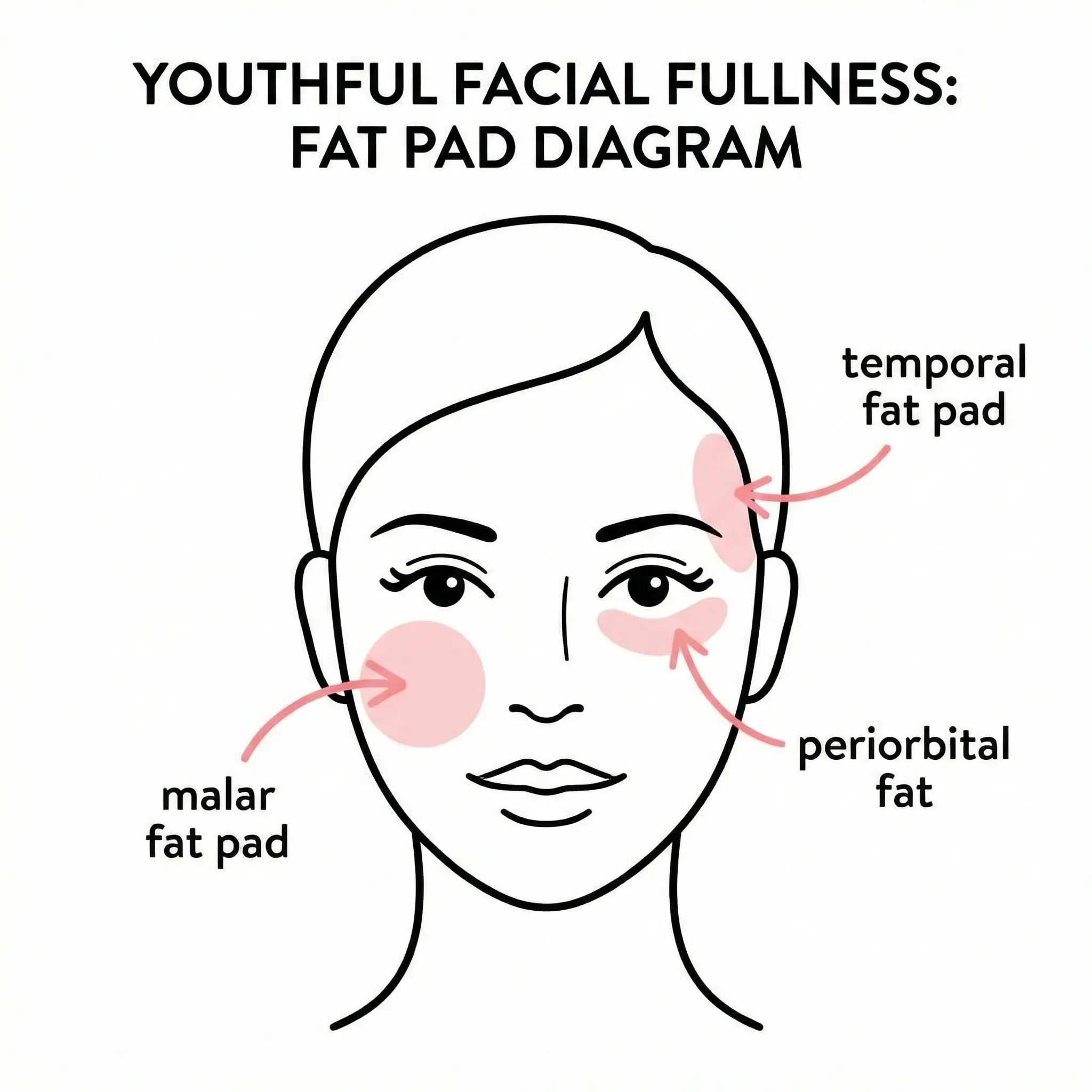
Your face isn't just skin and bone. It contains specialized facial fat pads — pockets of fat in your cheeks, temples, and around your eyes that create the soft, full contours we associate with youth. Think of them as nature's filler.
Here's the problem: you can't choose where fat disappears from. When you lose weight, your body pulls fat from everywhere — including these facial fat pads. A 2019 study in Plastic and Reconstructive Surgery found that facial fat loss is often disproportionate to body fat loss, especially in people over 40.
Meanwhile, your skin's ability to "bounce back" depends on collagen and elastin. According to dermatological research, collagen production decreases by approximately 1-1.5% per year after age 25 — a figure consistently cited across multiple peer-reviewed sources. By 50, you may have lost 25-30% of your skin's structural support.
This is why a 28-year-old can lose 40 pounds with minimal facial sagging, while a 52-year-old losing the same amount might look gaunt.
The "Ozempic Face" Phenomenon
"Ozempic face" describes the rapid facial aging some people experience when using GLP-1 medications like semaglutide (Ozempic, Wegovy) or tirzepatide (Mounjaro). Surveys of dermatologists and plastic surgeons consistently report significant increases in patients seeking facial rejuvenation treatments after GLP-1-induced weight loss — a 2024 Allergan Aesthetics survey found that GLP-1 patients per provider more than doubled from 2023 to 2024.
The medications don't directly age you — the rapid weight loss they enable does. When you lose weight too fast, your skin can't keep up.
5 Evidence-Based Strategies to Look Younger While Losing Weight
The good news: you have more control than you think. Research points to several strategies that maximize youthful results.
Strategy 1: Slow Down Your Rate of Loss
What to do: Aim for 0.5-1 kg (1-2 lbs) per week — no faster.
Why it works: A study in Obesity found that participants who lost weight at this pace retained significantly more lean muscle and experienced less skin laxity than rapid losers. Your skin needs time to contract gradually.
How to start: Calculate your timeline. If you want to lose 20 kg, that's 20-40 weeks — not 10. If that feels slow, remember: your face will thank you.
Strategy 2: Prioritize Protein
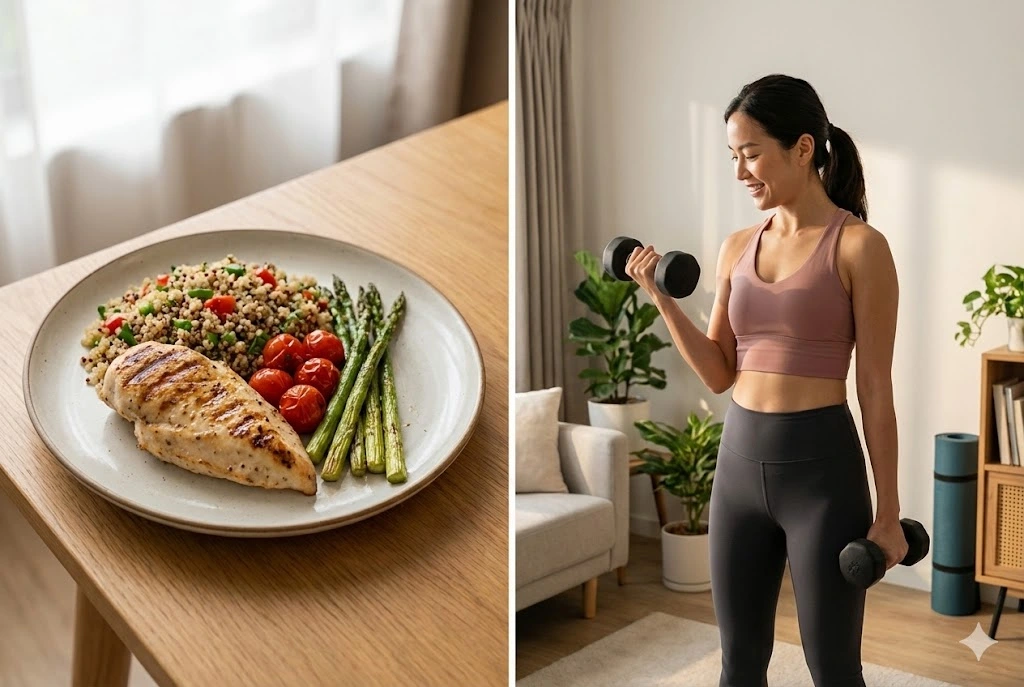
What to do: Aim for approximately 1.6g of protein per kg of body weight daily.
Why it works: A 2018 meta-analysis by Morton et al. in the British Journal of Sports Medicine analyzed 49 studies and found that protein intake beyond 1.62 g/kg/day showed optimal results for muscle retention during resistance training. This threshold has been consistently supported in subsequent research. Facial muscles matter too — they contribute to facial fullness.
How to start: Track your protein for 3 days using a free app. Most people discover they're eating half what they need. For protein-rich food ideas, see our guide on foods that make you look younger.
Note: Individual needs vary. Consider consulting a registered dietitian for personalized targets.
Strategy 3: Don't Skip Resistance Training
What to do: Strength train 2-4 times per week.
Why it works: A 2018 meta-analysis published in Nutrients found that adding resistance training to a caloric restriction diet prevented over 90% of the muscle loss that would otherwise occur from dieting alone. This effect was particularly significant in older adults.
How to start: Even bodyweight exercises count. Start with squats, push-ups, and planks — 20 minutes, 3x per week.
Strategy 4: Protect Your Skin (It's Non-Negotiable)
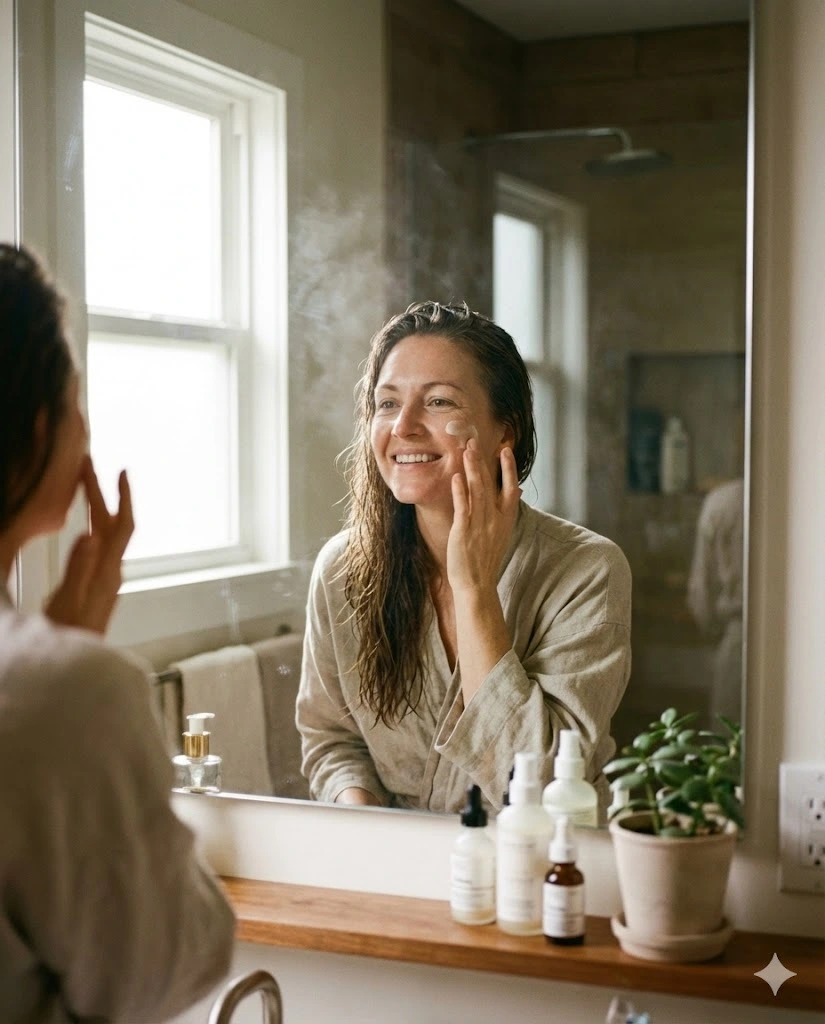
What to do: Daily SPF 30+, hydrating moisturizer, and consider retinoids.
Why it works: Research shows that approximately 80% of visible facial aging is attributable to sun exposure — making sun protection the single most impactful anti-aging intervention. A 4.5-year randomized trial published in the Annals of Internal Medicine (Green et al., 2013) found that daily sunscreen users showed 24% less skin aging than those who used sunscreen at their discretion.
| Intervention | Research Finding |
|---|---|
| Daily SPF 30+ | Addresses primary cause of visible aging (~80% is sun-induced) |
| Topical retinoids | Clinically proven to stimulate collagen production and reduce wrinkles |
| Adequate hydration | Studies show improved skin elasticity within 2 weeks |
How to start: If you do nothing else, start wearing sunscreen daily. Sun damage during weight loss is permanent. Sun exposure is one of 12 factors that accelerate aging.
Note: Prescription retinoids require dermatologist consultation.
Strategy 5: Prioritize Sleep and Hydration
What to do: 7-9 hours of sleep, 2+ liters of water daily.
Why it works: A study in Clinical and Experimental Dermatology (Oyetakin-White et al., 2015) found that poor quality sleepers (≤5 hours nightly) showed roughly twice the intrinsic skin aging scores compared to good sleepers (7-9 hours). Separately, studies show increased water intake improves skin hydration and elasticity within 2 weeks.
How to start: Set a bedtime alarm. Track water intake for one week.
→ Deep dive: Can You Reverse Aging from Lack of Sleep?
3 Mistakes That Age Your Face During Weight Loss
Knowing what not to do is just as important. These are the errors I see most often — and they're all preventable.
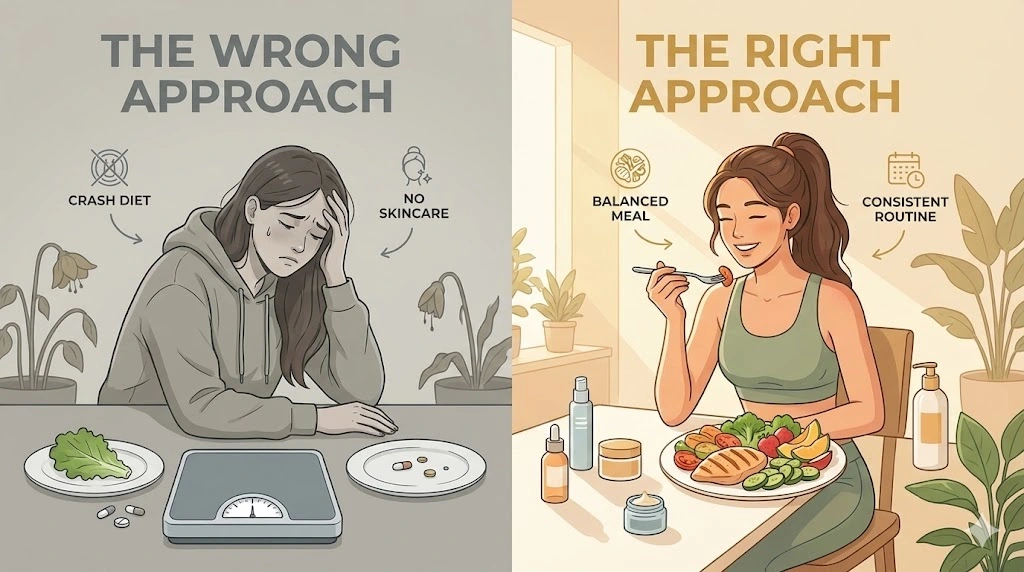
Mistake #1: Crash Dieting for Quick Results
The problem: You want to lose 10 pounds in 2 weeks for an event. So you slash calories dramatically.
Why it backfires: Rapid loss causes significantly more skin laxity than gradual loss. Your skin literally can't keep up. Plus, crash diets cause muscle loss, making your face look hollow rather than defined.
What to do instead: Start earlier. Give yourself 2x the time you think you need.
Mistake #2: Cutting Protein to Cut Calories
The problem: Protein is calorie-dense, so you focus on salads and fruit.
Why it backfires: Research consistently shows that inadequate protein during caloric restriction leads to significantly greater muscle mass loss — including facial muscles that keep your face looking full and youthful.
What to do instead: Cut carbs or fats before cutting protein. Protein is the last thing you should reduce.
Mistake #3: "I'll Focus on Skincare After I Lose Weight"
The problem: You're focused on the scale, so skincare feels like a distraction.
Why it backfires: Sun damage and collagen loss accumulated during weight loss is permanent. You can't undo 6 months of UV exposure after the fact.
What to do instead: Add SPF to your routine on Day 1. It takes 30 seconds and addresses the primary cause of visible aging.
Real Stories: What Actually Happens
Research is useful, but real experiences tell the full story. Here's what people on Reddit actually report:
The trade-off is real, but worth it:
"I'm 5'6", currently 39 years old and I lost 55 pounds about 4 years ago. My fine lines have become way more obvious and it has most certainly not improved whatsoever over time. No bounce back. Overall, I still think it's worth it because my body looks great, I feel better and my face is still decent. But it super sucks and makes me feel like I've aged over ten years."
— u/justalapforcats, r/loseit
Give your skin time to catch up:
"While I was actively losing I noticed the same thing. Took some months at my goal weight for 'my face to catch up' so to speak. I have visible nasolabial folds now, but my eyes look bigger, my features are more defined and overall I look younger now."
— u/OwlsDontCareForYou, r/loseit
Age matters for skin recovery:
"I went from 145kg to 100kg from October to January. I thought for sure I'd have heaps of loose skin but the amount of shrinking has been insane. Being 31 probably helps since I'm still in the age window for skin to be able to bounce back."
— u/Fainstrider, r/loseit
Key takeaway: Experiences vary by age and rate of loss. Younger individuals tend to see better skin recovery, while those over 35-40 may notice permanent changes. Giving your body time at goal weight can help skin adapt.
FAQ
Does losing 20 pounds make you look younger?
For most people, yes. Moderate loss reduces puffiness and reveals bone structure without significant volume loss. This is often the "sweet spot" where you look more defined and vibrant.
At what age does weight loss start aging your face?
Risk increases after 40, when collagen is down 15-20% and elasticity drops. But many people in their 40s-50s still look younger after weight loss — if they go slowly and support their skin.
Can I prevent facial sagging during weight loss?
You can significantly reduce it. Lose slowly (1-2 lbs/week), eat adequate protein, strength train, and use daily sunscreen. Genetics play a role, but these factors are within your control.
Will my face fill back out after weight loss?
Only if you regain weight. For volume restoration without gaining, dermal fillers (Juvederm, Sculptra) are the most effective option, lasting 6 months to 2+ years.
Is "Ozempic face" permanent?
Not necessarily. Some improvement occurs naturally as skin adapts over 12-24 months. Fillers can restore volume immediately. Slowing the rate of continued weight loss also helps.
Your 3-Step Action Plan (Start Today)
Don't just read — act. Here's what to do right now:
Step 1: Calculate Your Safe Timeline (5 minutes)
Take your goal weight loss in pounds. Divide by 1.5. That's your minimum timeline in weeks.
Example: Want to lose 30 lbs? That's at least 20 weeks (5 months). Mark the date on your calendar.
Step 2: Audit Your Protein Intake (10 minutes)
Look at what you ate yesterday. Add up the protein grams. Compare to your target (bodyweight in kg × 1.6).
If you're under 50% of target, that's your #1 fix this week.
Step 3: Get Your Baseline Perceived Age (2 minutes)
Take a clear, well-lit photo right now. Use our AI tool to see how old you currently look. Save the result.
Repeat monthly. If the number goes UP during weight loss, slow down your rate or add more skin support.
→ Try the How Old Do I Look photo test
Expected results: Following these steps, most people see positive facial changes (looking younger, not older) within 3-4 months of weight loss.

Bottom Line
Weight loss can absolutely make you look younger — when you do it strategically.
The research is clear: slow beats fast, protein preserves muscle, strength training matters, and sun protection is non-negotiable. The people who look older after weight loss usually made preventable mistakes.
You now know what they didn't. Use it.
→ Complete guide: How to Look 10 Years Younger: Science-Backed Methods
Ready to track your results? Get your baseline perceived age before you start — so you can measure real progress, not just scale numbers.
→ Try the free How Old Do I Look photo test
Last updated: January 2025
Disclaimer: This article is for informational purposes only and does not constitute medical, nutritional, or professional advice. The research cited represents current scientific understanding, but individual results vary. Consult qualified healthcare providers, registered dietitians, or board-certified dermatologists before making decisions about weight loss, nutrition, or skincare treatments.
Related Guides
Complete Guide:
Dive Deeper:
- What Makes You Look Older? 12 Surprising Factors
- Does the Sun Age Your Skin?
- Can You Reverse Aging from Lack of Sleep?
- 12 Foods That Make You Look Younger
- How to Apply Makeup to Look Younger
References
-
Morton RW, et al. (2018). A systematic review, meta-analysis and meta-regression of the effect of protein supplementation on resistance training-induced gains in muscle mass and strength in healthy adults. British Journal of Sports Medicine, 52(6):376-384. PubMed
-
Sardeli AV, et al. (2018). Resistance Training Prevents Muscle Loss Induced by Caloric Restriction in Obese Elderly Individuals: A Systematic Review and Meta-Analysis. Nutrients, 10(4):423. PMC
-
Green AC, et al. (2013). Sunscreen and prevention of skin aging: a randomized trial. Annals of Internal Medicine, 158(11):781-790. PubMed
-
Oyetakin-White P, et al. (2015). Does poor sleep quality affect skin ageing? Clinical and Experimental Dermatology, 40(1):17-22. PubMed
-
Allergan Aesthetics Survey (2024). GLP-1 patients seeking cosmetic care. Dermatology Times. Article
Try the photo age test
How Old Do I Look?
Upload a selfie or face photo and get an instant AI estimate of how old you look. Free, no signup required, and photos are not saved by us after analysis.
Test how old you look